ConduitAI: OT Network Isolation Workbench
An AI-assisted engineering workbench that turns plant packet captures, switch dumps and cabinet photos into a verified hardware data diode cutover plan (IEC 62443 SL-4), built for the Meta Global AI Developer Hackathon.
Overview
Built solo for the Meta Global AI Developer Hackathon 2026 (Indie Developer track, Push the Frontier), ConduitAI compresses weeks of OT network isolation planning into a verifiable engineering workflow. Given read-only site exports—SPAN packet captures, 24-hour firewall CSVs, switch CLI dumps, asset lists, cabinet photos, network drawings and voice notes—it inventories Layer-7 industrial flows, uncovers undocumented shadow hosts and firewall bypasses, sizes vendor-neutral hardware data diodes against physical rack or DIN-rail space, and proves the cutover plan by replaying real ICS attack packets down the plant's own paths before an engineer signs off.
The problem
Power substations, water utilities and factories are still bridged from their operational technology (OT) control networks to corporate IT through software firewalls or forgotten cellular modems, so one compromised office laptop can reach field equipment. Hardware data diodes enforce one-way physical isolation (IEC 62443 SL-4), but dropping a diode into a live plant breaks bidirectional polling between historians, SCADA servers and PLCs. Auditing traffic, inspecting cabinets, sizing hardware and planning which flows cross, reverse or get cut normally takes a senior OT network architect weeks.
Key features
- Layer-7 industrial packet decoding with Scapy and 24-hour firewall aggregation in DuckDB (Modbus, IEC-104, DNP3, S7comm, CIP, OPC-UA, BACnet)
- Shadow-asset and rogue-bypass discovery by reconciling switch ARP/MAC dumps and network drawings against inventory
- Propose-and-verify architect loop pairing Meta Muse Wonder (or open-weights Muse Spark Open) with a deterministic safety and sizing checker
- Physical rack-unit and DIN-rail measurement plus cellular-modem detection from cabinet photos via SAM 3.1 and Muse Spark
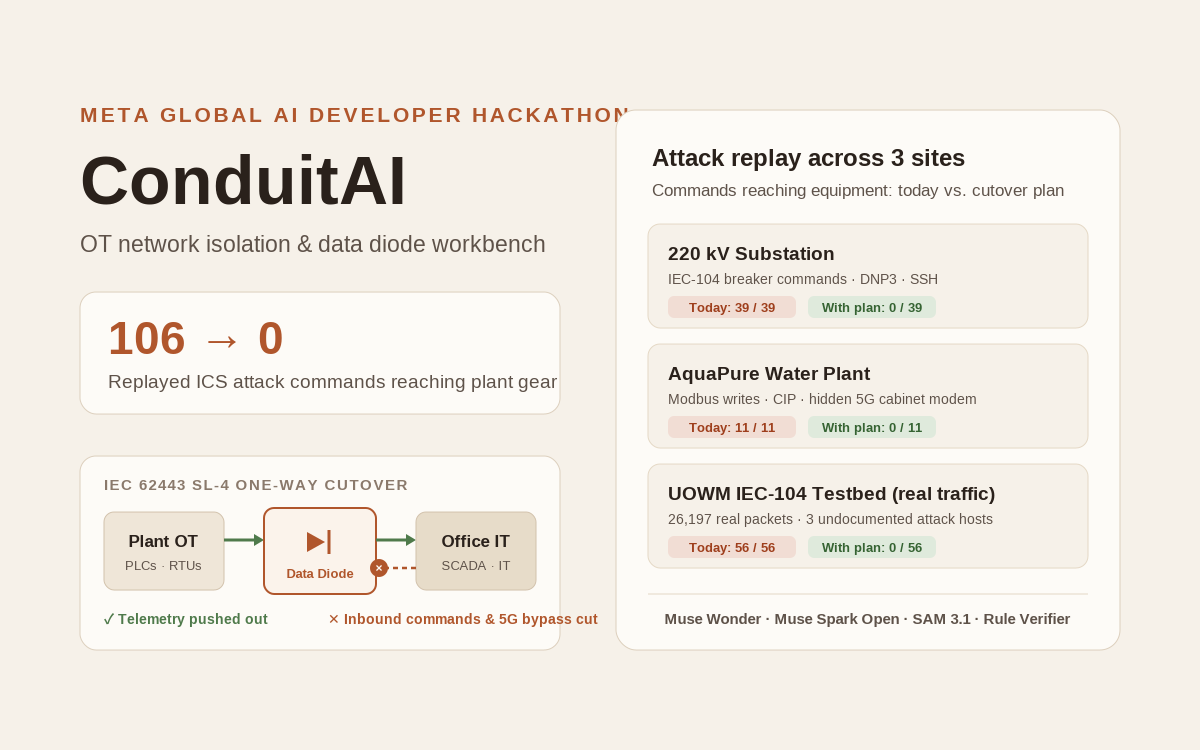
- Live attack replay using real ICS command packets down the plant's own paths (106 of 106 reach equipment today across three demo sites, 0 of 106 with the plan)
- Engineer review and fingerprinted sign-off with SHA-256 evidence manifests, switch cutover CLI, .drawio topology and IEC 62443 PDF handoff
What I did
- Built the seven-stage LangGraph pipeline across a FastAPI backend and Next.js (@xyflow) workbench during the hackathon window
- Wrote the deterministic rule verifier checking every draft against hard constraints (directional safety, protocol proxy support, bandwidth headroom, VLAN count, physical cabinet fit)
- Integrated six Meta models across cloud and air-gapped open-weights modes (Muse Wonder, Muse Spark Open, SAM 3.1, Muse Spark 1.3, Muse Voice Transcribe, Muse Image)
- Implemented geometric rack-U and DIN-rail calibration on SAM 3.1 bounding boxes with Muse Spark empty-slot verification and fail-safe handling on angled real photos
- Evaluated the pipeline against two synthetic plants, the public UOWM IEC-104 intrusion dataset (26,197 real packets) and 15 public CISA/UIUC ICS captures
- Recorded model outputs by content hash so the public Vercel demo runs packet analysis, verification and attack replay live with zero API keys
AI under the hood
ConduitAI runs six Meta models inside a seven-stage LangGraph pipeline, paired with a deterministic rule checker that has the final say on safety. SAM 3.1 segments equipment, empty rack slots, DIN rails and rogue cellular modems in cabinet photos, plus boxes on customer network drawings; Muse Spark 1.3 reads labels and IPs from those crops and confirms whether rack gaps are genuinely empty; Muse Voice Transcribe processes field audio notes and surfaces conflicts against measured evidence as explicit questions for the site; and Muse Image renders placement cards.
Muse Wonder acts as the architect, proposing a Green/Amber/Red cutover tier and action per flow alongside the diode bill of materials. Every draft is checked by plain-code rules for inbound command safety, protocol proxy support, throughput, VLAN limits and physical fit—across six unseen public ICS captures, 4 of 12 model drafts were rejected and fixed on the second attempt (including one where an inbound synchrophasor stream was relabelled as plant-initiated). For utilities that cannot send plant telemetry to a cloud API, an Air-Gapped mode runs the architect and vision checks on open-weights Muse Spark Open with the same verifier.